Counting Back From Fall Freeze Dates for Late Harvests
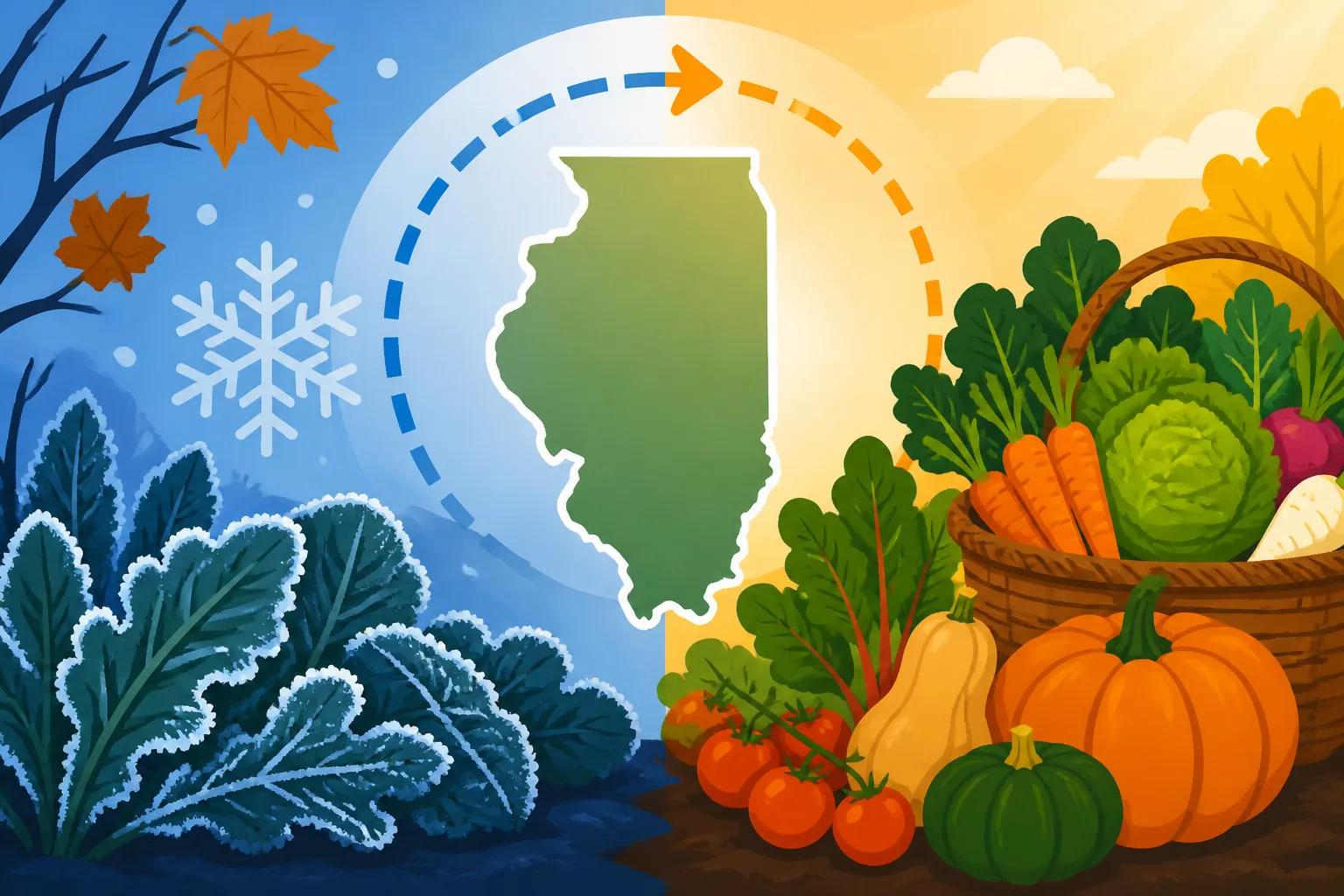
Late-season planting can feel like a race: sow too early and a crop may struggle in summer heat, but sow too late and frost may arrive before harvest. A useful plan starts with the likely fall freeze, then works backward from each crop’s maturity time. This approach helps Illinois gardeners compare options, set realistic expectations, and leave room for weather uncertainty.
Start with a local fall freeze estimate
A fall freeze date is a planning reference, not a guaranteed deadline. The weather can turn colder earlier or later, and conditions differ across Illinois. A garden in a built-up neighborhood, a low spot, or a sheltered yard may not experience the same conditions as a nearby open area. Use a locally relevant estimate rather than assuming that one date applies throughout the state.
The goal is not to predict the exact evening frost will arrive. It is to decide how much growing time a crop needs and whether there is enough room between sowing and a reasonable end-of-season estimate. That makes the freeze date one part of the calculation, alongside the crop’s maturity information, the garden’s conditions, and the kind of harvest you want.
The Illinois State Water Survey, Prairie Research Institute advises: In fall, subtract two weeks from the average date to be on guard against early frost. Treat that adjustment as a planning buffer, not a promise that frost will happen on a particular day. It gives you a more cautious date to use when deciding whether a late sowing is practical.
If you are comparing local estimates, check what each one represents. A date described as an average is not the same as a date tied to a particular probability of frost. The station or area behind an estimate matters, too. A regional calendar can help you get oriented, but the conditions at your own garden may differ. For more help interpreting the estimates, see How to Read Autumn Freeze Probability Tables for Garden Crops and Illinois Frost Dates Guide: Spring Thaw to Autumn Freeze.
It also helps to separate a forecast from a long-term estimate. A forecast can alert you to an approaching cold spell; an average date helps you plan well ahead of that forecast. As autumn approaches, pay attention to current local forecasts and be ready to revise plans if they suggest an earlier cold snap. The calendar gives you a starting point, while changing weather can call for a new decision.
Once you have a local estimate, work backward from the date when you want the crop to be ready, not just from the date you hope to sow it. A crop that needs time to size up may still be edible before it reaches its largest or most mature stage. Decide whether your goal is a full-size harvest, a smaller tender harvest, or simply a chance to gather usable leaves or roots. That distinction changes what “enough time” means.
Read maturity information before choosing a sowing date
The maturity estimate on a seed packet or plant tag is the practical starting point for counting backward. Always review plant tags and seed packets, as University of Illinois Extension advises, to confirm how long a crop takes to mature. Check the specific crop information you plan to use rather than relying on a memory of how long a similar crop took in a different garden.
Maturity information is useful, but it is not a guarantee. The actual pace of growth can vary with weather, soil, sunlight, moisture, plant health, and the way the crop is grown. Cool conditions can slow growth; stressful heat or dry soil can interrupt it. A packet’s estimate helps you compare crops and plan a reasonable window, but the garden may not match the conditions behind the estimate exactly.
Pay attention to what the stated maturity period measures. For a crop started directly in the garden, the packet may count from sowing. For a transplant, the tag may describe time from transplanting or may present a different measure. Read the wording carefully, because counting from the wrong starting point can make a late-season plan look more workable than it is.
Some vegetables are harvested while young, while others need time to reach a fuller size. Leafy crops can often provide usable leaves without every plant reaching a mature head. Root crops may be edible before reaching their largest size, though the harvest will be different. A late sowing may therefore be worthwhile even when there is not enough time to expect the crop’s largest or fullest form.
Use the maturity estimate as a comparison tool. If two crops have different maturity needs, the one with the shorter stated interval may offer more flexibility for a late planting. That does not automatically make it the better choice: a crop must also suit the garden’s light, soil, moisture, and the gardener’s intended use. A realistic plan balances these considerations rather than relying on a single number from a packet.
For a closer look at using this information, see Using Days to Maturity to Time Autumn Garden Sowing and Illinois Growing Seasons: Counting Days to Maturity to Frost. When a crop seems close to the edge of the available season, Matching Vegetable Maturity Days to Illinois Freeze Dates can help frame the comparison.
A simple worksheet can make the decision clearer:
- Write down the local average fall freeze estimate you are using.
- Apply the cautious fall adjustment described above.
- Note the crop’s maturity wording and the point from which it is counted.
- Count backward from the adjusted date, allowing for the crop’s actual purpose and the uncertainty of garden conditions.
- Decide whether the result leaves a comfortable margin or makes the planting a gamble.
You do not need to turn this into a precise prediction. The value of counting backward is that it shows whether a crop is a good fit, a possible experiment, or a poor use of a limited garden bed.
Choose crops and harvest goals that fit the remaining season
Late-season planning works best when you choose a crop for a specific harvest goal. If you want a full-size, long-season vegetable, count backward using the maturity information for that crop and be conservative about the available growing time. If the calculation leaves little room for delays, consider a quicker crop or a smaller harvest target.
Cool-season crops are often useful candidates for autumn sowing because many gardeners grow them as temperatures cool. Leafy greens and some roots can be harvested at different stages, which gives more flexibility than a crop that must reach a particular mature form before it is useful. Even so, a cool-season crop still needs enough time to establish and grow. A label that sounds promising does not remove the need to check its maturity estimate.
A late planting can also be valuable when the plan is to harvest young leaves or smaller roots. For example, a gardener who wants tender greens may not need every plant to reach its full mature size. A gardener who wants substantial storage roots may need a longer window. Make that choice before sowing, so expectations match the time available.
Pay attention to how much of the harvest depends on one plant reaching a particular stage. A single large head, fruit, or root may be harder to count on than a crop that can be harvested gradually. Repeated picking can spread the harvest across a longer period, while a one-time harvest places more pressure on the crop to mature before cold weather interrupts growth.
For a late harvest, the garden bed itself matters. Soil that drains poorly, stays compacted, or dries quickly can affect establishment and growth. A bed that has produced healthy crops earlier may still have problems after repeated plantings, so observe its condition rather than assuming that a new sowing will grow at the same pace as an earlier one. If the soil is dry, water it appropriately; if it is saturated, wait for conditions to improve before disturbing it.
Make room for the crop’s needs as it develops. Late-season plants may share space with summer crops that are still producing. Avoid crowding new seedlings into a shaded or congested area simply because the bed is available on paper. Good light, reasonable spacing, and consistent moisture help a crop use the time it has, though they cannot erase the risk of an early freeze.
The seed packet may also list more than one planting window. According to University of Illinois Extension, when two planting dates are listed, the crop can be planted and harvested twice, for both a summer and fall crop. Read those dates in context: a fall planting window is not a promise of success in every Illinois garden, and the maturity information still needs to fit the local season.
For a broader look at coordinating crops, see Coordinating Spring and Fall Vegetables Across Illinois and Illinois Vegetable Planting Dates by Region: Spring and Fall Schedules. If you are deciding between crops that can be sown directly and those usually started as transplants, Direct Sowing vs Transplanting in Illinois Garden Beds can help you compare the planning trade-offs.
Build a cautious count-back plan
A useful count-back plan has a little more detail than “sow by this date.” It identifies the harvest goal, the maturity period, the local freeze estimate, and the uncertainty that could shorten the season. Once you have those pieces, you can decide whether to plant, choose a different crop, or protect the harvest as conditions change.
Start by choosing a local average date that reasonably represents your garden. If your yard is in a colder pocket or has a history of early frost, do not rely on a more sheltered nearby location just because its estimate looks more favorable. Likewise, a warm urban site may not match an open rural station. Microclimates can shift the conditions in a small area, but they should be treated as a reason to observe your garden, not as a guarantee that frost will stay away.
Next, use the fall adjustment to create a cautious planning date. Count backward from that point using the maturity information on the packet or tag, paying attention to whether it starts from sowing or transplanting. If the crop needs to be harvested at a particular stage, consider whether the remaining window seems realistic under ordinary garden conditions.
Then add a margin for uncertainty. Seedlings may take time to establish. Soil can be cooler or drier than expected. A spell of adverse weather can slow growth, and a freeze can arrive ahead of the average. The appropriate margin depends on the crop and your tolerance for risk; there is no single buffer that works for every garden and harvest goal.
Finally, record what you decided. Note the sowing date, the crop, the packet’s maturity wording, and what the weather and harvest were like. A garden journal turns each late planting into useful local information. If a crop regularly falls short of the desired size, try sowing earlier next season, choosing a crop with a shorter maturity estimate, or accepting a smaller harvest. For help setting up a record, see Keeping an Illinois Garden Journal for Varieties and Yields.
A practical decision can fall into one of three broad categories:
| Count-back result | What it suggests | A sensible response |
|---|---|---|
| Comfortable room remains | The crop appears to have a workable window, though weather is still uncertain. | Sow as planned, keep the bed cared for, and monitor forecasts as autumn approaches. |
| The window is tight | A delay or early freeze could prevent the intended harvest. | Choose a quicker crop, harvest young, or plant only an amount you are comfortable risking. |
| The window is too short | The expected maturity period does not fit the cautious planning date. | Skip that crop for now or choose a different harvest goal. |
The table is a decision aid, not a forecast. A “comfortable” window can still end with an early freeze, and a tight window may still produce something useful. The point is to make the trade-off before investing time and garden space.
For crops that need a long warm period, a late sowing may be less practical than it first appears. The plant may germinate and grow, but still not produce a mature harvest before cold weather. The more the crop depends on sustained warmth or a long development period, the more important it is to leave a generous margin. Using Freeze-Free Season Length to Schedule Warm-Season Crops offers related planning context.
Protect the harvest and adjust as autumn approaches
Counting backward helps decide what to plant. It does not end the planning process once seeds are in the ground. As the season changes, keep watching the crop and the weather. If growth is slower than expected, adjust the harvest goal. If a cold spell appears likely, gather mature or usable produce rather than assuming that the average date will provide protection.
A forecast of frost risk is a cue to assess the garden, not a reason to treat every crop the same way. Some crops are more vulnerable to cold than others, and damage can depend on the severity and duration of the cold as well as the plant’s condition. Check what is likely to be affected, then decide whether covering, harvesting, or accepting some loss makes sense for your situation.
Use protection only when it fits the crop and the expected conditions. Covering can help reduce exposure during a cold night, but it is not a guarantee against every freeze. Materials need to be suitable, placed so they do not damage plants, and removed or adjusted when conditions change. See Protecting Garden Vegetables When an Illinois Cold Snap Threatens and Using Row Covers to Plant Earlier in Illinois for more on protecting garden crops.
Harvest decisions can be staged. If a crop has some usable leaves, fruits, or roots, you may be able to gather part of it before a cold spell and leave the rest to continue growing if conditions permit. This reduces the chance that the entire harvest depends on one final stretch of favorable weather. For tender crops nearing the end of the season, Harvesting Tender Garden Crops Before Late October Frost Dates provides related guidance.
Do not wait for a perfect calendar day to make every harvest decision. Watch for signs that the crop is ready, and pay attention to forecasts and garden conditions. If you want to extend a harvest, consider whether the plant is still growing actively and whether protection is practical. If the crop is already mature, harvesting it may be a better choice than risking damage for a small amount of additional growth.
Late-season sowing also benefits from a realistic sense of what counts as success. A full, uniform harvest may not be the only worthwhile outcome. A smaller picking of greens, a few usable roots, or an extended harvest from plants that were already established can still make good use of the garden. But if the crop’s intended use requires a large, fully mature product, it is better to recognize that constraint before planting.
For crops intended to provide an extended autumn harvest, sowing time and harvest style need to work together. Sowing Late-Summer Greens for an Extended Autumn Harvest and Counting Back Crop Days to Northern Illinois October Freezes offer more focused approaches to those situations. Keep the local freeze estimate in view, but let the crop’s actual growth and the current forecast guide the final decisions.
Frequently Asked Questions
Is the average fall freeze date a guaranteed last day to harvest?
No. An average is a planning reference, not a promise. Frost can arrive earlier or later, so use a cautious adjustment and keep an eye on forecasts as autumn gets closer.
Should I count maturity time from sowing or transplanting?
Use the wording on the specific seed packet or plant tag. The starting point can differ, and counting from the wrong point may give you an inaccurate sense of how much growing time remains.
What if the count-back suggests there is not enough time?
Choose a crop with a shorter maturity estimate, set a smaller harvest goal, or skip the late planting. A crop can still produce something useful in a tight window, but the result is less predictable.
Can I sow a crop again if the packet lists a fall planting date?
A listed fall date can indicate that another planting is intended, but local conditions and the crop’s maturity period still matter. Match the planting to your local freeze estimate and the harvest you want.
Sources
- University of Illinois Extension — When to Plant | Home Vegetable Gardening | Illinois Extension | Illinois (checked November 15, 2026)
- University of Illinois Extension — When Plant Illinois (PDF) (checked November 15, 2026)
- Illinois State Water Survey, Prairie Research Institute — Freeze Dates & Growing Season | Illinois State Climatologist | Illinois State Water Survey | Prairie Research Institute (checked November 15, 2026)
Disclaimer
This article is for general informational purposes only and does not constitute professional advice. Laws, prices and regulations vary by location and change over time. Consult a qualified professional for guidance on your specific situation. Illinois Gardening Guide is not a government agency and is not affiliated with any university extension, state department of agriculture or other government agency.